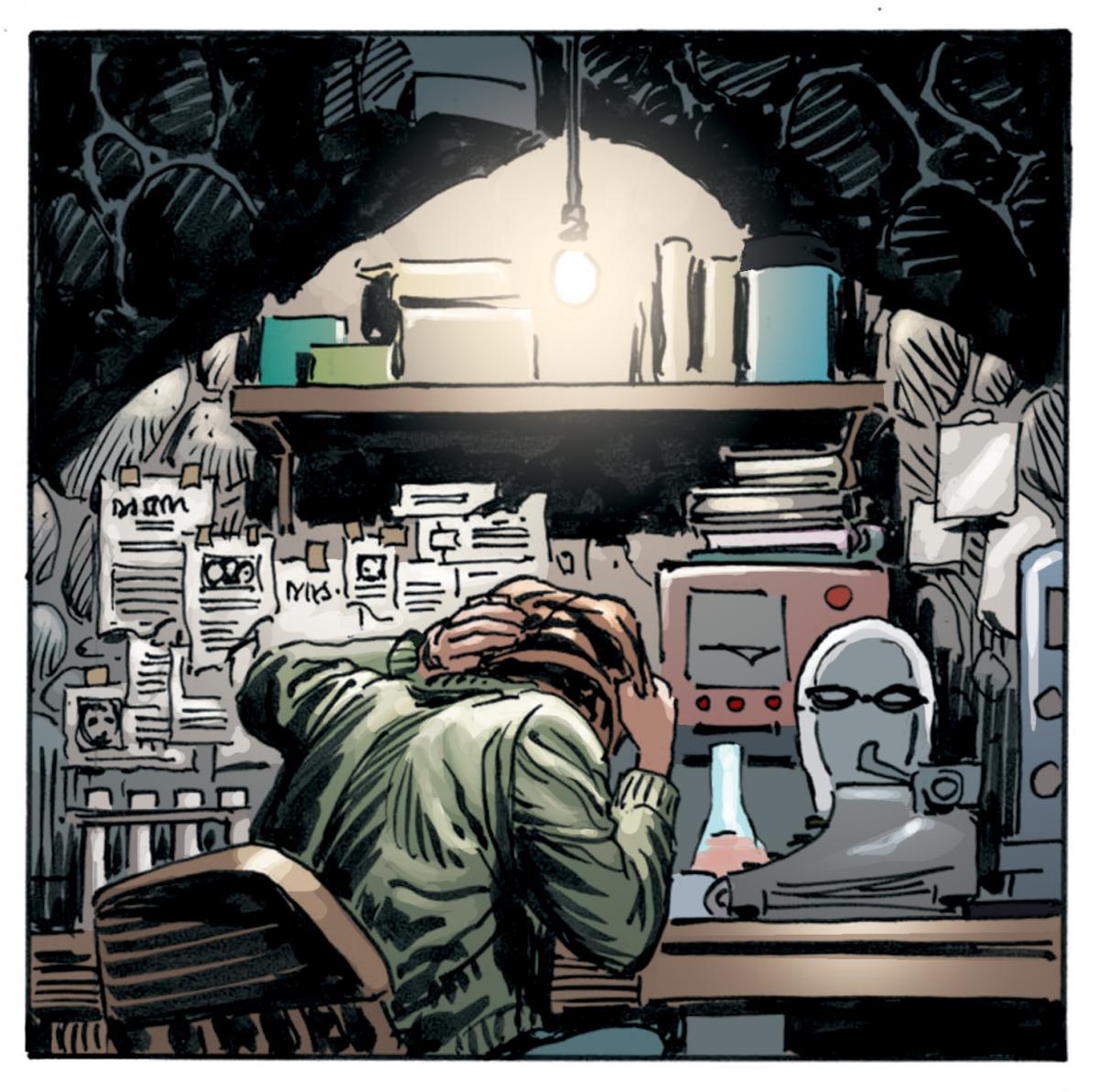
Watchmen got me into comics, so when I heard about DC's plan to launch 'Before Watchmen,' unlike a lot of comics fans, I was pretty psyched. I mean, I love the characters, I love the universe, and because
Watchmen was what opened up the entire medium to me, I feel a sentimental attachment to the property.
Of course, I have my reservations. Isn't part of the brilliance of Moore & Gibbons'
Watchmen its narrative singularity, the fact that the six-issue series stands apart as a comment on superhero comics as much as it is a total story in and of itself? Yes, but unlike some purists (I would say, killjoys), at the same time as I entered into the realm of reading and collecting comic books, I entered into the bizarro alternate universe of comics fandom.
Watchmen fandom to be exact. In this world, the characters belong to us--the fans--and we may tinker with them as we wish, rewrite their deaths, fill in gaps in the canon, write about before and after the official beginning and ending of the series.
And isn't that what's happening here? Sure, it's on a terrible, soul-crushing, DC-sanctified corporate level and not a cool, underground, indie slashfic level, but what's the difference? Anyone who knows comics knows writers, artists and companies reinvent, retcon and otherwise draw and quarter their own creations in a ouroborosistic orgy of cannibalism on a regular basis. At least DC hired some cool people to honor/destroy/do absolutely nothing drastic or permanent to the legacy of the greatest comic book of all-time.
Yadda, yadda, let's get to the books.
 Minutemen #1 by Darwyn Cooke
Okay, so maybe I'm not to be entrusted with objectivity here, but in my mind, Darwyn Cooke is the perfect man to handle the
Minutemen, who were the Watchmen before 'Before Watchmen.' Meta-meta-meta,
woah. In my opinion, Cooke's epic
DC: The New Frontier is second only to
Watchmen in its thorough, enthusiastic, gorgeous, heartbreaking de- and re-construction of the origin and myth of the American superhero.
As an artist, Cooke's commitment to mid-century retro aesthetics is a welcome asset to the story of Golden Age crime fighters. Indeed, I think Cooke's attention to fabrics, shading and the overall tactile quality of the character's costumes actually adds a new dimension to Dave Gibbons' original artwork.
Watchmen itself was full of extra-textual pieces on the Minutemen that were not, strictly speaking, part of its linear storytelling. You could certainly read #1--6 of Watchmen without reading the supplementary excerpts from 'Under the Hood' and get along just fine. In this regard, Minutemen #1 is sort of a supplement to a supplement, with 'Under the Hood' author Hollis Mason (aka Nite Owl) walking the reader through the history of the Minutemen.
Hollis recalls how, while still a New York policemen, he first encountered Hooded Justice. Cooke's reveal of the vigilante is terrifying and suspenseful, dousing the page in striking red (the first appearance of that color in the book). He goes on to introduce all the players: Sally Jupiter (aka Silk Spectre), Edward Blake (aka The Comedian), Byron Lewis (aka Mothman), patriotic superhero for hire Dollar Bill, and mostly touchingly, Ursula Zandt (aka The Silhouette). In Moore & Gibbons' Watchmen, Silhouette is alloted only a few panels and her intriguing and heartbreaking backstory is only alluded to by other characters. In Minutemen #1, Ursula gets four whole pages of introduction (as much as Cooke gives Nite Owl, his narrator), giving us a glimpse into the character's crime-fighting never seen before.
This is the stuff of fandom heaven. This is the kind of thing I wanted to see from 'Before Watchmen': fan favorite characters actually being given stuff to do. I want to see Silhouette busting up a child pornography ring; I want to watch her take down bad guys; I want insight into her background in Nazi-occupied Austria. There's nothing in the first issue to suggest that isn't exactly the kind of storytelling we're going to get from Cooke's series.

But as much time as Cooke spends giving us the run-down on characters, he's crafting a larger portrait of how these disparate vigilantes came together as the Minutemen. Using minor characters like Sally Jupiter's manager/husband Larry Schnexnayder, Cooke begins to connect the dots between the 'before' and the 'after' events of the Watchmen universe. The book ends with the reveal of Nelson Gardner (aka Captain Metropolis), the former marine who founded the Minutemen. Like many of the minor characters from Watchmen, very little is known about Captain Metropolis and what little we can piece together of his background is mostly speculative. It's exciting to watch how Cooke weaves together all these characters, incorporating the history of Watchmen while setting future events in motion. But the first issue gives little indication on what kind of story Minutemen will tell. Will it be a retro action book? Will it flash forward to Hollis and Sally Jupiter's involvement in Watchmen's main story, or will it stay in the 1940s? I could even envision different issues having a different narrator. Whatever the future holds for the 'Before Watchmen' Minutemen series, I know I'm in good hands with Darwyn Cooke, and that at the very least, each new issue will deliver the gorgeous, detailed artwork and lovingly crafted characterizations that are the Cooke's signature.

Silk Spectre #1 by Darwyn Cooke & Amanda Conner
Silk Spectre is the hardest damned
Watchmen character to write for, and just as hard to defend. Both Sally Jupiter (Silk Spectre I) and her daughter Laurie (Silk Spectre II) are burdened with being the only female characters of much importance in the
Watchmen universe, and are therefore saddled with every expectation of women, ever. It was Alan Moore's intention to use Silk Spectre(s) to investigate, comment upon, and ultimately critique the issues surrounding female superheroes (their intense sexualization and fetishization for male audiences); but like most minority representations, those stereotypes were also enforced.
And, so, with all this baggage, I was still excited by the prospect of a Silk Spectre book drawn by Amanda Connor (goddess of lady superheroes and all around incredible artist) and written by my fav Darwyn Cooke, who's partly my fav because he's generally pretty fair-minded when it comes to giving female characters some depth and integrity.
But we seem to run into some issues right away because Watchmen already covers the time when Laurie is very young. How much 'Before Watchmen' could there possibly be? As a second generation superhero, Laurie was born into the business; in fact, her whole life is defined by Watchmen. Is it actually possible to sincerely explore her other facets without totally re-writing the character? After reading Silk Spectre #1, I still have my doubts.
The story takes place in 1966, when Laurie is sixteen (the same age she was when she started dating Dr. Manhattan). It primarily concerns (and stop me if you've heard this one before) her strained relationship with Sally as mother/sensei/best friend/public embarrassment, her burgeoning attraction to A Cute Boy, and The Mean Popular Pretty Girls at school who are all about slut-shaming and being catty about Sally Jupiter's rather scandalous superhero past. The latter issue is the one I found most interesting because, really, being a teenager with an overbearing mom is enough without that mom having been the spread-eagled subject of a Tijuana Bible.

As much as Cooke's writing succeeds in capturing some of the genuine naivete and insecurities of teenage life, it's Amanda Conner's art that really makes this book. I especially loved the little fantasy inserts of Laurie's inner-thoughts (a compliment from her crush rings wedding bells and a tift with her mother conjures hellish caricatures). There are also many mirrored images of Laurie and Sally that visually signify their co-dependent yet adversarial relationship, and also serve as references to Dave Gibbons' constantly referential and recursive artwork in Watchmen. Silk Spectre #1 carries over the snow globe symbolism in Watchmen to this book, and all of the other visual in-jokes (Sally and Laurie both checking themselves out in the mirror, both dissatisfied by what they see) are excellent touches. Perhaps the greatest of these are two panels that reference key events in Laurie's life and in the Watchmen series as a whole: after sparring with her mother, Laurie is seen in close-up with a trickle of blood spilling from her nose; after receiving a chaste kiss from A Cute Boy, Laurie imagines herself jumping for joy on the moon. Oh, if only she knew how that one turned out.


As an interesting footnote: of all three 'Before Watchmen' books released so far,
Silk Spectre #1 is the only one to stick to
Watchmen's rigorous nine-panel format (see above). Even though the story of
Silk Spectre #1 is one of teen angst, infatuation and rebellion (in Connor's signature expressive, cartoony style), in terms of how the panels look on the page (and within the individual panels themselves), this is the closest the 'Before Watchmen' comes to actually looking like
Watchmen.
The story proper wraps up with Laurie running away with A Cute Boy and, since this is 1966, hitchhiking with some hippies to San Francisco. This seems like a cop-out. Hippies? Please. But maybe this title will take us to some weird and unexpected places. Will everyone's favorite hashish-tripping, vision quest-taking, vegetarian, utopian fascist
Adrian Veidt show up? Fingers crossed.
Comedian #1 by Brian Azzarello and J.G. Jones
Azzarello is no stranger to high-profile investigations of the psychotic mind (see:
Joker), so when it was announced he'd be penning
Comedian, I think everyone's reaction was kind of a collective, "Well, duh." Eddie Blake is the biggest bastard of the
Watchmen universe (well, I guess that's debatable). At any rate, he is, to outward appearances, the most repugnant anti-hero, a ruthless sociopath who views the world as a sadistic joke. Fun times, kids! The Comedian made a career out of violence, working for whatever government would pay him to assassinate whatever political obstacles needed to be erased.
It is this side of Eddie Blake--the political mercenary--that Azzarello focuses on in Comedian #1. The issue courts controversy immediately with a scene that sees a youthful Eddie playing football with Teddy and John F. Kennedy at Martha's Vineyard. Why controversy? Well, because in Watchmen it is heavily implied that The Comedian assassinated JFK (the film version goes so far as to depict it). With this in mind, Azzarello spends the entire book toying with our expectations and preconceived notions of Blake's involvement, his political convictions, and even his influence in the U.S. government.
Blake is all about machismo, gun-toting terror and skull-crushing thuggery. He fancies himself the big man on campus, and when that illusion is shattered, The Comedian's tearful disillusionment triggers Watchmen's famous first scene: the assassination of Edward Blake. Whereas Watchmen can, in some ways, be boiled down to a 'Who killed Eddie Blake?' murder mystery, 'Before Watchmen' seems to hint at an earlier moment of The Comedian's self-doubt.

There is a lot of cool, alternative history going on in Comedian #1 (as there should be in the Watchmen universe), but I wonder if Azzarello isn't taking things a bit too far too early. Without giving everything away, at the end of this issue, Blake finds himself a pawn in a much larger game. It stuns him and leaves him wondering 'what next?' The last five pages of the book are absolutely haunting, giving us Blake as helpless bystander; we watch him watching a horrific historical event, instead of enacting one. Something about that passivity is deeply disturbing. I don't know if this series will offer up a more empathetic Comedian (I sincerely hope not; Blake is a grade-A son of a bitch and I'd hate to see that image softened), but it does seem to hint at a more vulnerable one.
J.G. Jones is is the artist for this series, and though I always like to see Azzarello commune with his go-to guy Eduardo Risso, I'm glad Jones was chosen for this project. Risso's art, all deep blacks and scratchy pencils, is often a paean to aestheticized ugliness, but in delving into Eddie Blake's history, I feel like we're drudging up enough ugliness already. Jones has a clean, realistic style (his Kennedy boys are dead-ringers) that lends the book a grounding in historical reality, even while writing concocts layer upon layer of metafiction. The tension between the storytelling and the art is something I really look forward to in future issues.