June 16, 2010

The Keaton Shorts: 1920--Intro & One Week

January, 1920. You're Buster Keaton, twenty-four years old. You've just been given your own studio in Hollywood, the top gagmen and cameraman in the business and your boss is patient and understanding: Just give me two two-reel (about twenty minutes) comedies a year, he said, and do it however you choose. The boys and girls of "Buster" Keaton Studios, located on the same square block where Charlie Chaplin churned out shorts for Mutual five years earlier, get busy immediately. Buster Keaton would produce twice the requisite number of shorts that year (his first effort, The High Sign, he would hold back till a year later.) It's a period of unparalleled creative freedom in Keaton's career, and arguably, among the whole of Hollywood history. Never one to be confined indoors, Keaton often shot on location and his early shorts portray Hollywood in its infancy, a dusty desert of infinite possibilities.


Long before the studio system codified and regimented its production practices, Keaton & co. were creating and perfecting the language of screen comedy. Between 1920 and 1923, Buster produced nineteen comedy shorts. He wrote (although those crazy kids never wrote anything down--conceived is a better word), directed and starred in all of them. But even those simple terms are inadequate to describe the workings of "Buster" Keaton Studios. Everybody did everything. If another actor was needed, they threw in co-writer/director Eddie Cline. Keaton worked out sets with the indispensable Fred Gabourie, technical advisor, set-builder, special effects guru and all-around right hand man. Buster also had the best cranker in the business, Elgin Lessley, the cameraman Keaton dubbed "the human metronome" for his precision. Together, they'd create some of the most spectacular special effects in silent cinema. "Writer's meetings" consisted of Keaton and his crew bouncing around gag ideas--plot was confined to the beginning and the end (the middle would work itself out). Often, whole days were spent ruminating over a studio game of baseball. Keaton would play third base, working out his choreography, the physical exertion stimulating the creative process, resulting in some of those most athletic, kinetic films ever made.


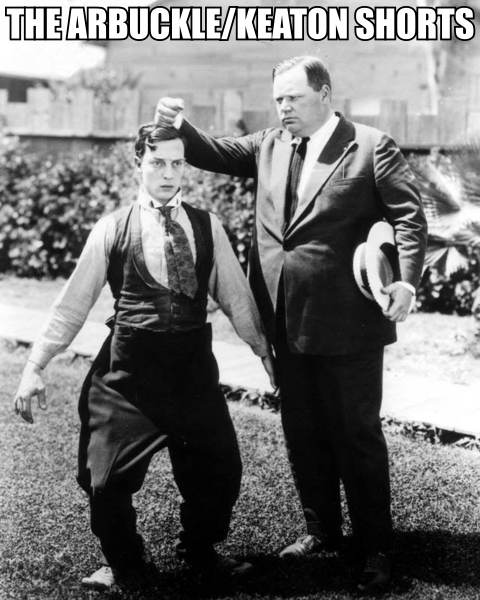
This first year of production, 1920, is a mixed bag. The four films Keaton released this year--One Week, Convict 13, Neighbors, and The Scarecrow (The High Sign will be counted for 1921)--give a glimpse into an artist whose strong personal aesthetic is immediately evident, although there are stylistic remnants of Buster's time at Comique with 'Fatty' Arbuckle. It's a transition year; the next, 1921, is probably the best in Keaton's entire career. But, enough from me--on to the films!


A note on credits: All films are co-written and co-directed by Keaton and Eddie Cline.


One Week


The first released Keaton short is also among his best. There are two basic Keaton plots: the rival/villain storyline where the object is to somehow get the girl, and the setting/prop-based gag-fest where most of the action is contained in one place (usually a house) and silliness occurs. One Week is an example of the latter. Buster and Sybil Seely play newlyweds who're given a pre-fab house and a plot of land as a wedding gift. A former rival, still seething over his loss of the lovely Sybil, sabotages their happiness, changing the numbers on their DIY house-building kits. Keaton regular Big Joe Roberts, not yet in his regular position as dramatic heavy, has his first role as a piano mover.


The action of the story takes place over one week (hence the title), each scene beginning on a shot of a calendar, the days being torn off one by one. The first day, Monday the 9th, starts out with a couple bad omens. Some pranksters have attached a sign to the couples' wedding car: "Good luck. You'll need it." When they arrive at plot 99, a man drops off their house in a box that looks ominously like a coffin. Gulp.


Tuesday, the 10th. The rival switches the numbers on the box. Intrepid Buster saws a danging plank of wood, not realizing that he's sitting on the portion suspended in mid-air. He cuts the plank and down he goes! Sybil, all sweetness and light, pities her well-meaning hubby and gives him a kiss for support. Aw. In a re-staging of Arbuckle's gag in Back Stage, Buster stands still as a side of the house falls to the ground--he's saved by standing in the window. This stunt would gain Keaton fame (and infamy) on a much larger and more dangerous scale eight years later in Steamboat Bill, Jr.


Wednesday, the 11th. Success! Their house is assembled. Too bad it's a design only Salvador Dali could love.


Buster, tools in hand, is perplexed. How...? The effervescent Sybil exclaims, "Oh, I don't think it's so bad!" as she paints two hearts on the side of the house. Buster examines this strange and lovely creature he's married, then cups her head in hands and plants a sweet kiss on his new wife. He walks away shyly before scampering off. It's a blissful scene of young love and one of my favorite scenes in any Keaton film. Buster isn't usually remembered for his tender moments but he and Sybil make a charming pair.


Wednesday, the 12th. This little vignette illustrates why I'm a little biased in my love of One Week, and these early Keaton shorts in general--they feature my favorite of Buster's leading ladies, Sybil Seely. Seely, an 18-year old unknown, immediately took to Buster's style of comedy. Although it's been argued that women in Keaton's films are never more than props (not really a criticism, since Buster himself is as much as ragdoll as anyone else), Seely's presence in One Week especially, speaks to a certain pragmatic romanticism in Keaton's work. Sybil and Buster are man and wife and what's more, they're a team. They're cute and flirty, but more than that, they complement each other. Buster is a husband who's charmed, intrigued, baffled, terrified by---and deeply in love, with his new wife. Sybil is a stalwart champion of her husband, helping with the building and the cooking, trying as much as he is to make their prefab housing disaster a home. But she's not a pushover; she's got spunk.


In one of the scene's most memorable moments, Sybil's in the bathtub, about to lean over to pick up a bar of soap. Suddenly, she becomes aware of the camera, smiles, and the cameraman's hand comes out of nowhere to cover the lens. Our vision restored, Sybil starts to scrub, giving us a coy, knowing smile. It's a wonderful moment for several reasons. First, it's a rare instance of Keaton giving a great gag to one of his female co-stars. Second, it's a great example of the playfulness and ingenuity which characterize Keaton's short films. Unlike the mugging employed by Arbuckle and the Comique crew, when Buster breaks the fourth wall, it's always unexpected--as a director, he's constantly uprooting our expectations. We might anticipate the film would cut away from Sybil and then cut back, the cameraman's hand is not something we might see coming.
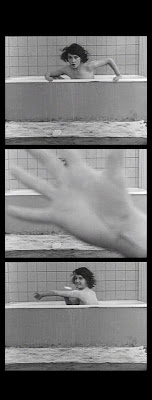


Furthermore, although the gag is unconventional, it's thematically consistent. In the next scene, Buster falls through the roof--right into the bathtub! Sybil is now behind the shower curtain (subverting our expectations again), and quickly shews him out, out, out! of the bathroom. The film viewer, is privy to certain intimacies (Sybil in the tub) that even her husband isn't allowed to see. Ever dutiful, Buster obeys his wife, opening the door--the film quickly cuts to outside the house, where we see that the door opens out into thin air and Buster takes a giant, Wile E. Coyote-style dive from the second story.


Friday, the 13th. The seemingly innocuous calendar gag pays off--it's a wonderful, unexpected laugh. It's the house-warming party, just in time for a massive storm to hit! The roof leaks, the house (which was affixed to a giant, in-studio turntable) turns and tilts on its axis, chucking guests out its doors and windows and into the muck. Buster is likewise tossed outside and trying in vain to get back inside the front door.


Saturday, the 14th. We iris out on a totally wrecked house, Buster and Sybil seated in a mournful embrace, sopping wet and completely dejected. Another blow: they learn they've build on the wrong lot. Hitching up the house on barrels and towing it with their car, the couple sets out to move across the street.


Sunday, the 15th. Towing the car across the way, the rope snaps. Undaunted, Buster nails the house to the car and drives away...only the car splits in half, the chassis driving away, leaving the seat nailed to the house. Just then, Buster and Sybil hear (and feel) a train coming and try desperately to move the house off the tracks. Just as it seems train and house are about to collide--the camera pans right and we find the train is running on the next track over. They're saved! Perhaps their luck is finally changing. The camera pans back to the couple braced for impact. They're relieved but immediately take to arguing (Buster, what did you do to the car?!)--we switch to a long shot just in time to see a train coming from the opposite direction, on the parallel track, slam into the house!


Well, that was just the last straw. Buster grabs a "For Sale" sign from the rubble, leaves the the directions and walks away from the mess, hand in hand with Sybil.


One Week is a near-perfect comedy. For only his second feature as a director, incredibly, Buster's screen persona is fully formed--the diligent little fellow who's battered with all sorts of bad luck, be it man-made (a booby-trapped house, a train) or natural (a storm); these leitmotifs will recur in Buster Keaton's best films. Interestingly, One Week is more domestic than many of Buster's shorts. Usually, Buster is trying to court the girl; here, he's already got her. His relationship and rapport with Sybil Seely adds an extra dimension to what would otherwise be just another bout of mechanical mayhem.

June 15, 2010

Buster & The Saphead

With Roscoe Arbuckle moving on to star in his own feature films, Buster Keaton was out of a job--albeit, very temporarily. He immediately started hounding his boss, producer Joseph Schenck, to make features. Schenck refused. In 1919, neither Chaplin nor Lloyd had started making feature-length films and Keaton's star power was unproven as of yet. Instead, Schenck decided to test the waters, loaning Buster out to Marcus Loew, head of Metro Pictures (later to become the the first M in MGM). Schenck and Loew, business partners since the early years of the century, had already decided that Metro would distribute Buster's contractual two two-reel pictures a year. But first, Buster would headline a seven-reel picture based on the great Broadway splash "The New Henrietta." The film was a safe bet, a slight comedic melodrama starring veteran stage actors like William H. Crane who would reprise his role from the 1913 stage production. It had already been filmed once, in 1915 as The Lamb. Douglas Fairbanks had played the lead role. It was an easy fit for Buster. Schenck wanted to see if he could drum up interest in his future comedy superstar and Loew wanted to class up Metro. When Fairbanks declined to revisit the role for the third time, The King of Hollywood suggested Keaton for the part himself. 


Buster plays Bertie Van Alstyne, the simple son of Nicholas Van Alstyne, the imposing Wall Street titan nicknamed "The Old Nick of The Street." Bertie is a gentle dope who accidentally saves his father's fortune from the designs of his ne'er-do-well brother-in-law. The story is a pat melodrama of scandalous affairs, a broken engagement, high stakes financial trading and the absurdly wealthy but irrepressibly likable hero--Buster. And although the film handsomely mounted, well shot and features some very beautiful title cards, Keaton's performance is assuredly the best thing about it. The film is pleasantly diverting but Buster plays Bertie with such a genteel passivity, it's hard not to become captivated by his character's emptiness. It's a screen style unusually restrained for the era, like all things Keaton, decades ahead of its time.

We're first introduced to Bertie at breakfast one day, well into the afternoon. He's a pampered little wisp of a man. He's seated on a chaise in bathrobe, munching on egg, toast, and tea, in that order. Servants surround him--Who sir like the light suit or the dark suit? Would sir like the rose or the tulip for his lapel? And although we start out laughing at him, poor Bertie becomes a victim of his cruel brother-in-law Mark and we're soon back on his side, rooting the weakling on. His stiff, stunted gait conveys a young man not frightened of a world he doesn't understand, but merely hesitant, like a young fawn, curious but cautious. Buster plays sadness magnificently throughout, the way his head lulls slightly on stooped shoulders, as if the weight of it were pulling him down and propelling him forward. 


One particular scene portends the kind of hard luck characters Buster would make famous. One night, Bertie goes out gambling with some chucklehead chums. At the roulette table, he's quietly fascinated by the spinning wheel, following the ball with his head, around and around. He wanders off between spins, perhaps in a daze, perhaps just admiring the gaming room's decor. His friends pull him back to the action. Somehow, and without even trying, Bertie manages to win thirty-eight thousand dollars. Just then, cops raid the club. Spotting an opportunity to enact some advice he'd read in a dating guide, Bertie bribes the policeman to arrest him so as to increase his playboy cred (afterall, what woman can resist a badboy?). The copper looks him up and down, pockets the bribe, and shows Bertie the door. Bertie's father is too powerful a figure to get him arrested. Stymied and rejected, Bertie sits on the curb in his tophat and tails, watching the paddy wagon drive off with all his friends inside. It's a classic Keaton pose that will become something of a trademark, seen here for the first time.


The climax, which takes place on the floor of the stock exchange, features Buster's only stunts of the picture. In the trading melee, Buster is tossed head over heels by the crowd, flipping several times before hitting up against a wall. His hat's been punched in. His nicely tailored suit is in tatters. Somehow, the gentle Lamb has managed to become a heroic lion, although not without some personal injury. 


Although not a terrific picture, The Saphead isn't terrible, either. And at a time when Metro's longest feature was five reels (about 50 minutes), The Saphead's seven reel length was quite an achievement. Buster's notices were terrific. He was immediately christened a brilliant comic action, which may explain why his later shorts and features (especially the early shorts) were so critically well-regarded. In fact, the production was going so well that Schenck decided to give Buster double-duty: he began filming his first two-reelers during the latter half of The Saphead. Keaton was well on his way to becoming a comedy legend.

June 14, 2010

Buster & Fatty: The Garage (1920)


The Garage (1920)

The Garage is the last and best of the Arbuckle-Keaton two-reel shorts. I say best, of course, from a Keatonian standpoint; perhaps diehard Arbuckle fans would disagree. In this short, Buster has reached the status as full partner to Arbuckle, the two men are working at a garage and doubling as volunteer firemen. Al St. John, recently given his own series of shorts to star in, is nowhere to be seen.

The setting provides manifold gag opportunities and is conspicuously Keatonian in its propensity with mechanical devices (there’s a giant turntable used by drying off cars). In one of the best jokes, a man comes in wanting to rent a car but when he drive away, it promptly and totally collapses—the tires pop off, the fender detaches, and the convertible roof accordians back. The man returns to the garage, stunned, and asks for another car, this time remembering to tip. He emerges with a shiny new vehicle, one that works perfectly.

Another excellent Keaton gag involves a giant billboard of the Scottish comic Harry Lauder. Buster, having recently lost his pants to a voracious dog (Luke, again) is walking around in a barrel, desperately searching for adequate clothing lest he be arrested. Enter Sir Harry, dressed in kilt and tam o’shanter. Using a pen knife, Buster cuts away the clothes like paper doll’s and when the cop approaches, Buster looks just like any ordinary Scotsman…that is until he turns around (poster are only one-dimensional, after all).

The film’s finale involves a fire and our two volunteers running after it, only they don’t know that the fire is at their own garage—they’ve been sent on a wild goose chase. With the garage owner’s daughter Molly trapped in the blaze, Buster and Fatty double back in time to witness her jump onto a trampoline being held some brave citizens…only to bounce off the trampoline and land splayed on the telephone wires above. D’oh! Our heroes to the rescue. They scale the telephone pole, gingerly climb out to the dangling girl, and using Buster as a human ladder, she’s able to scale down and land safely on the ground below. Buster has a mite more trouble with Fatty. But just as Arbuckle is beginning to slip out of grip, Molly comes around with the car where Fatty lands with Molly safely in the back seat and Buster lands in the driver’s seat. They drive away happily as the garage burns to the ground.


In silent cinema, film was often tinted red to connote fire.


A note on viewing practices: The best way to watch all the Buster & Fatty shorts in one place is The Best Arbuckle/Keaton Collection on DVD. This two-disc set includes all of the films above, except for The Cook which was re-discovered after the DVD came out. 

You can get The Cook by itself on DVD as well. The company that puts out the Arbuckle/Keaton Collection also has a YouTube channel where you can watch The Butcher Boy and The Rough House for free. In addition, archive.org has several Arbuckle-Keaton shorts and some have been uploaded to YouTube and Google video. The A-K Collection is in pretty good shape, the transfers coming from the 35mm negatives. Some are tinted sepia (The Hayseed, His Wedding Night), which was the original coloring of the film upon its release.

Next time we'll delve into Buster Keaton as a solo artist. In the span of three short years, and at the age of twenty-four, Buster was head of a studio that bore his name and was contracted making two two-reel pictures a year. And lo, they were good. See ya for the next installment...

June 13, 2010

Buster & Fatty: The Hayseed (1919)


The Hayseed (1919)

In contrast to Back Stage, The Hayseed is a much more modest and traditional picture. It’s also somewhat of a disappointment. In keeping with its rural setting, nothing much happens in the picture. Fatty has a girl, Molly (Molly Malone again), and a rival, the sheriff. Buster plays his friend and driver. The main conflict is who will marry Molly first, the noble but poor Fatty or the crooked sheriff. Like I said, not much of a plot. The gags aren’t anything to write home about either. The bright spots of the short are Luke the dog, who is adorable, a fine actor and admirable stuntdog.

The main action in the picture is a town social they hold at the general store. In an interlude, Buster performs a magic act wherein he produces a rabbit from behind a sheet. The illusion is successful until his assistant turns his back to the audience to reveal the rabbit dangling from a hook on his coat. In real life, Buster Keaton was friends with Harry Houdini while they traveled together in medicine shows around the turn of the century. Buster was a gifted magician and often included sleight of hand tricks in his films. To see him perform such an inept magic act, then, is amusing if you know the backstory, but not amusing enough in itself to qualify as a successful gag. Also at the talent show, Fatty sings. Complaining of a sore throat, he eats dozens of green onions (apparently they have some kind of medicinal properties). Unfortunately, when he speaks to anyone, he stinks up the joint! It’s a lame premise of a joke, executed lamely, chiefly because we can’t hear Fatty sing and the period tunes he choose don’t exactly resonate with modern audiences. Also, bad breath jokes? They just don’t cut it.

Professor Onion >>>> stinky green onions

Though not a very successful picture, The Hayseed does highlight a recurring feature of the Arbuckle-Keaton shorts: the act of performance for performance’s sake. In several of these two-reelers the action stops so that the characters can perform in some way either for a gathered audience or more likely, purely for the enjoyment of the film audiences. These dances, magic shows, and songs are part of a larger self-conscious style of performance that includes knowing winks and references to the audience watching the film. Fatty constantly stares into the camera to bring attention to a certain joke or talk to the audience. Today, he would be considered breaking the fourth wall, but at the time, the code for film (especially comedies) was more flexible. They were making up the rules as they went along and especially in the short form (in 1920, comedies were all two-reelers; no feature-length films yet), experimentation and innovation were the name of the game. In Keaton’s own films, even the shorts, he adopts a more mannered, mature style where self-referentiality is slyly inferred, never outwardly expressed. Keaton’s so-called “Stone Face” was an extension of that rigidity; Buster much preferred to manipulate the medium with trick photography, letting the film speak where he didn’t.


June 12, 2010

Buster & Fatty: Backstage (1919)


Back Stage (1919)

Their next feature, Back Stage, is one of their absolute best and maybe the most Keatonesque. Fatty, Buster, and St. John play stagehands at a vaudeville theater dealing with a whole lot of trouble in the form of a diva-ish leading man called Julius Hamlet Omlette, an “eccentric dancer” played by Buster’s father, Joe Keaton, and a surly strongman called Professor Onion. Prof. Onion has a pretty assistant (Molly Malone), whom he abuses terribly and one of the best aspects of the picture is how the boys rally together to protect her and sabotage Professor Onion. Perhaps because of the mens’ vaudeville backgrounds, Back Stage is infused with the warmth of nostalgia, and with Onion already in place as the villain, it frees up Buster, St. John and Fatty to work together as friends, a side rarely shown in the usual romantic rival plotline.

The diabolical Professor Onion

Having driven away the strongman and the actors, the boys (with the help of the assistant) have to put on the show themselves. Buster and Fatty suit up for an exotic, Middle Eastern-infused dance. Fatty plays the King…and Buster plays the Queen. They ham is up in magnificently straight-faced candor. In the next scene, Arbuckle and Keaton introduce a gag that Keaton would perfect a decade later in Steamboat Bill, Jr. Fatty is serenading the girl, she in a house window, he on the stage. Suddenly, the façade of the house falls down around Fatty, who’s saved because he’s standing right where the window is. The girl is revealed to be seated on a ladder. The illusion of theater is shattered. The vaudeville audience loves it, prompting us, the film audience to clap and laugh in turn.

Just then, Professor Onion returns to pull a John Wilkes Booth, shooting the assistant from the balcony! Buster grabs a rope and pulls a Douglas Fairbanks, swinging to the balcony, grabbing the Prof in a headlock and hauling him back to the stage. The boys work together to lift all the Professor’s weights into a trunk and then drop the trunk on Onion’s head. Crisis averted—and the show’s a hit!

Back Stage prefigures Keaton’s The Playhouse in the way it reveals the artifice of theater. The short also features strong characterization and an unique plot that distances itself from the normal romance and chase-heavy comedy two-reelers at the time. The film is lively, inventive and a lot of fun.

June 11, 2010

Buster & Fatty: The Cook (1918)


The Cook (1918)

The Cook was only recently discovered, having been thought lost forever, and it’s a great find. The film was the last short made before Keaton shipped off for World War I and it marks a turning point in the Arbuckle-Keaton relationship. In The Cook, Keaton really takes the lead; he commands the first half of the picture, which takes place at a beachfront café, the Bull Pup. Arbuckle is the titular cook but Keaton, billed as “pest waiter,” steals the show with his antics. He tries to seduce the customers and in the best scene in the picture, does an uncanny imitation of the floorshow belly dancer’s snake routine. 

In fact, there’s a lot of dancing going on in The Cook. Buster and Fatty get into a dance competition in the kitchen, each ignoring their duties in an effort to top each other’s moves. It’s a charming scene that builds on the gentle comedic chemistry the two men have. The first half of the picture is really just a showcase for Buster and Fatty to riff off one another in a series of little bits of business. Buster will come in the café, shout a customer’s order and Fatty will stylishly flip a pancake or pour out the order from a keg that seemingly has an ability to dispense whatever is needed (coffee, milk, soup, ice cream, and even Fatty’s jacket); it’s a wonderfully subtle gag that gets funnier every time it’s used.

Adding to the hilarity is The Toughest Guy in the World (Al St. John), a pushy customer who raucously dances with Buster’s gal, the cashier (Alice Lake). When Buster objects and threatens Guy with a bottle, St. John takes the bottle, bashes it on Buster’s head, bites off the top of the bottle, drinks the liquid, spits it at Buster, and proceeds to eat the entire bottle as if it was candy (in reality, the prop was probably made of liquorice). Al St John is hilarious in this bit and if you look closely, you can see Buster trying not to laugh, a hint of a smile creeping onto his features before the scene cuts.

The film is divided in two parts, the second scene taking place on the café employees’ day off. Buster takes the cashier to a seaside amusement park, and Fatty takes his dog Luke (played by Arbuckle’s real-life pooch) fishing. Both men end up at the wonderfully named Goatland, an area where, as far as I can discern, couples pay to take romantic goat-drawn cart rides. It’s awesome. While Fatty trots off to fish, Buster and his girl encounter goofy evil incarnate: St. John as The Toughest Guy! In a beautifully framed and shot sequence, Guy chases the girl up the park’s rollercoaster. Threatened with imminent defilement, the girl has no choice but to jump off the coaster into the ocean.

Buster and Fatty scramble to find a rope with which to save her. In a spectacular stunt, Keaton grabs a rope that nailed into the ground, runs away and when the rope pulls taut, he launches his body 360 degrees in a mid-air in what martial artists call a butterfly kick and lands right on his butt.


Pffft, women!: romantic advances rebuffed

The Cook is one of the best Arbuckle-Keaton shorts and a real treasure to rediscover after all these years. It’s a nice combination of gentle, character-based comedy and the raucous, high-action chase sequences silent film does best. Great stuff.

June 10, 2010

Buster & Fatty: Good Night, Nurse! (1918)


Good Night, Nurse! (1918)

Good Night, Nurse! is probably best remembered as the short where Buster and Fatty (in drag, naturally) flirt up a storm—they smirk, they grin, they play coy, Fatty bites his finger suggestively and Buster shyly scratches at the door. It’s an overwhelmingly ridiculous scene made bearable, delightful even, by the actors’ natural charms. 

But first, the plot: Fatty is a bum whose wife gets fed up of his drinking and carousing and has him admitted to a sanitarium to dry out. Buster plays an over-eager surgeon who, when introduced, has a rather ominous amount of blood on his smock. Al St. John plays his assistant. Also joining the fun are Alice Lake as a crazy inmate who takes an immediate liking to Fatty.

As soon as Fatty enters the facility, of course, he tries to escape. Buster and Al struggle to strap him down to a table and in one neat shot from Fatty’s point of view, the camera looses focus as he fades into an ether-induced sleep. What follows is madness: Fatty changes into a nurses’ uniform in an escape attempt (therein lies the flirting), he engages the staff in the wildest pillow fight with the highest down-count I’ve ever seen, and accidentally enters a race for ‘200-pounders’ and wins. However, these events turn out to be too good to be true: it really has been a dream all along. Fatty wakes up on the ether table once more and the film ends.

Unfortunately, the ‘it was all a dream’ conceit feels more like a cheat than a narrative innovation. The film’s pacing is somewhat wonky and some characters, especially the crazy girl, feel tacked on. Good Night, Nurse! is not the best Arbuckle-Keaton outing, although definitely not the worst thing you could choose to watch.

June 9, 2010

Buster & Fatty: Moonshine (1918)


Moonshine (1918)

Moonshine is, unfortunately, an incomplete film, the existing print running only a little over six minutes. What is there, though, is the makings of a classic short. Filmed on location in the California hills, Fatty is a reveneur hot on the trail of some nasty bootleggers, among them Al St. John. Buster is Fatty's diminutive assistant. The two comedians are not yet on equal footing as partners.

Buster Keaton, Roscoe Arbuckle and Al St. John behind the scenes while filming Moonshine.

The film's one remaining standout sequence is an elaborate and impressive trick shot where it appears that several dozen men emerge from a single car.

Edward McPherson explains how they got the shot in his biography Buster Keaton: Tempest in a Flat Hat: "The clown-car setup was Buster's idea. He taped off the camera lens, splitting the car down the middle. When the camera rolled, the men filed straight through the vehicle, entering (unseen) through one passenger door and emerging (on film) out the other side. After they were all "out of the car," the film was rewound, the lens re-masked to expose only the opposite side of the car (with its door closed), and the camera cranked through to the end" (McPherson, 49). It's a wonderful gag that gives us a glimpse into Keaton the filmmaker whose later triumphs like The Playhouse and Sherlock Jr. would also utilize similar in-camera wizardry.


June 8, 2010

Buster & Fatty: The Bell Boy (1918)


The Bell Boy (1918)

The first intertitle informs us that the action takes place at the Elk's Head Hotel--third rate service, first rate prices. Buster and Fatty play layabout bell boys and St. John plays the desk clerk. When Cutie Cuticle, manicurist (Alice Lake) comes to stay at the hotel, all hell breaks loose as the boys fall all over themselves to accommodate her every whim. In my favorite gag, Fatty, doubling as a barber, shaves a customer with a very intimidating full beard. Ascribing to the comedy golden rule of threes, the first time Fatty shaves him, the man ends up looking like General Lee (Fatty adorns him with a cigar and a Union cap); shaving a little more, the man looks like Abraham Lincoln (Fatty places a stovepipe hat atop his head); the third time, Fatty shaves him, glues back some whiskers for a turned-up mustache, turns a basin over for a helmet and pins a paper cross to his chest--it's Kaiser Wilhelm! Anticipating the boos in the WWI-era audience, Fatty slathers the man with shaving cream and runs away. There's another anti-German gag in the film where the sign in the dining room, "French and German Cooking," the "and German" has been crossed out in pen.

The main comedy bit, however, comes from the elevator, which is powered by a mule pulling ropes outside the hotel. Buster becomes stuck in the elevator when St. John can't get the mule to budge. Fatty tries leveraging the elevator with a plank of wood, but to no avail. Suddenly, the mule runs forward, dropping Buster down to the ground and launching Cutie (who was standing on the plank of wood) onto the elk's head adorning the wall. Buster bravely volunteers to get Cutie down and in the process becomes stuck himself. It is a gag that Buster will repeat in a later sound film short.

In the second half of the film, Fatty hatches a plan: to get Cutie to think he's heroic, Buster and St. John will pretend to rob the nearby bank, Fatty will foil their plot and they'll get away. Unfortunately for them, real robbers decide to show up at the exact same time.

The fight between the two groups is epic, shot on a cut-away set so that Buster and St. John can get tossed from one room to another, through walls and onto tables, in one continuous motion. It's a well choreographed fight that demonstrates Buster and Al's agility (at one point, Buster does flips and jumps across three room sets, bounding across the frame like a gymnast on the floor exercise). Ultimately, The Bell Boy is about a mid-level Arbuckle-Keaton picture, with a conventional plot but an interesting enough setting to supply funny gag possibilities throughout.


June 7, 2010

Buster & Fatty: Out West (1918)


Out West (1918)

Out West is sensational short which is set apart by its beautiful, stark photographic style and sharp and incisive send-up of the Western genre. The film opens with a shot of a train--enough to send a thrill down the spine of any Keaton connoisseur. Fatty plays a drifter riding the rails to no place in particular. He's chased off the train and into the dusty desert by some rough-looking men who don't appreciate him stealing their lunch. In the harsh wilderness, Fatty sees a miracle, a pretty spiffy special effect for 1918. He's chased into town by some very hungry (and anachronistically cannibalistic) Native Americans, where he meets Buster playing Bill Bullhorn, the owner of a saloon so tough, it has a trap door for dead bodies. Our villain tonight is played, as always, by Al St. John as the rough, impetuous Wild Bill Hickup. Rounding out the cast is the lovely Alice Lake as the kind-hearted Salvation Army girl. Fatty and the girl instantly strike up a romance, to which Wild Bill vehemently objects.

The beautiful desert photography is one of the main draws of the picture.

I'm a really big fan of Westerns so perhaps this short appeals to me more than is typically, but I think it really hits all the right spots. Generally, Arbuckle plays it pretty safe. There is some impressive, Western-ish camerawork here and the extras all look sweatily & dustily authentic. I can't help but speculate that Keaton was inspired by the scope and tone of this picture (and the presence of trains) in making is later period films Our Hospitality and The General.

There is one gag here that I think is particularly brilliant and caught me completely off guard. In order to best Hiccup and save the Salvation Army girl, Buster and Fatty must find his weakness. But he's a rugged gunfighter! What could it be? Simple: the outlaw is fiendishly ticklish. That's right. The sight of Buster and Fatty trying not to crack a smile while tickling the heck out of Al St. John, decked out in his sheepskin chaps, well, that's just downright delightful. Several bits comment on the silliness of Western tropes, as when Fatty tries to knock Hiccup out by smashing a bottle on his head. It doesn't work the first time so he tries dozens of bottles, doing nothing but getting him wetter and wetter. The climactic battle is also a commentary on how useless guns are for actually killing people (and guns seemingly never run out of bullets). Buster is engaged in a gunfight with a Mexican and the two shoot at each other for several minutes, the scene cuts to other action and then back, and the two are still shooting. Even after Keaton lands what appears to be the death blow, the Mexican gets up and rides away.

Deadeye Buster.

For me, Out West is a refreshing change of pace from the modern comedies that make up most of Comique's output. Buster actually gets to play a character here and there's not a porkpie in sight. Interestingly, Comique script girl Natalie Talmadge, who would later become Buster's wife, is credited with the story credit.